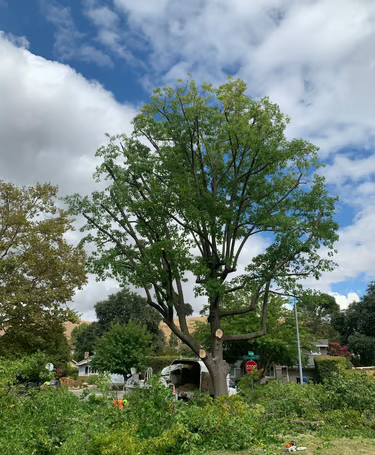
Yes, you need city approval before removing a protected tree in Fremont or Hayward, and private ownership does not by itself exempt a tree from local rules. Hayward's published guidance identifies an 8-inch trunk-diameter threshold and a 4-inch threshold for certain native species, while Fremont requires a separate check of protected status, parcel conditions, and landmark designation before a removal can be cleared.
How do you check the rules for your actual address?
Start with the city that governs the property, not the mailing address alone. A Fremont rule does not apply simply because the contractor works in Fremont, and a Hayward mailing address should not replace checking jurisdiction. Give city staff the street address and explain whether the work is connected to construction.
Then distinguish a private tree from a street tree or a tree in the public right-of-way. A tree between a curb and sidewalk may have a different approval process. An HOA's permission also does not substitute for a city permit. You may need both, depending on the property.
Gather the species if known, trunk measurements, a photo of the whole tree, and your reason for removal. A dead or damaged appearance is information for the review, not automatic permission to cut. Keep any required approval with the job records before the crew starts.
Which Fremont trees need a removal permit?
Fremont's property owner tree permit page is the starting point for private-tree work. Protected status can involve tree size, species, development conditions, required replacement planting, and the parcel itself. Do not assume a tree is unprotected merely because it stands in your backyard.
[Placeholder F1: Confirm Fremont's current trunk-diameter thresholds, measurement method, native or exceptionally adaptable species rules, and development-related exceptions with Urban Forestry.] Published secondary summaries report several size triggers, but we have not independently confirmed their complete current scope in the city code. We will not turn an incomplete summary into permission to remove your tree.
[Placeholder F2: Confirm Fremont's current permit trigger for parcels over 10,000 square feet and how it interacts with protected-tree rules on smaller lots.] Ask the city to check the actual parcel. A lot-size rule should not be treated as a blanket exemption for everything below that size.
For a street tree, confirm the city's contractor and permit requirements before arranging work. A California contractor license alone should not be presented as proof of any additional city-approved contractor status.
What makes Fremont's landmark trees different?
Fremont calls its specially designated historic trees “Landmark Trees.” The city's landmark-tree page says designated trees are protected and can only be removed with City Council approval. That is a separate issue from ordinary protected-tree review.
The city's inventory connects trees with places such as Shinn Historical Park, Niles, and Ardenwood. Use the inventory and staff confirmation to check a specific tree; do not assume that every old oak is designated or that an unlisted tree is otherwise unprotected.
[Placeholder F3: Confirm the current landmark designation criteria, any applicable size thresholds, and the approval sequence for the specific tree.] Age, appearance, and trunk size can be relevant, but we do not publish an unverified number as the complete landmark test.
How do you apply in Fremont, and how long does it take?
- Ask Urban Forestry which permit or review applies to your address and tree.
- Obtain the current private-tree application or the appropriate street-tree instructions.
- Provide the requested tree details, removal reason, photographs, and site information.
- Respond to requests for inspection, supporting assessment, or replacement information.
- Wait for written approval and review every condition before scheduling the work.
Ask whether a development application changes the process and whether the tree needs separate landmark review. The information required for an ordinary backyard removal may not be enough for a project involving grading or construction.
[Placeholder F4: Confirm Fremont's current application fee and typical processing time for this permit type, including any separate landmark review.] We do not promise a number of days or borrow a timeline from Hayward. Missing documents and additional review can delay a decision.
What are Hayward's published diameter thresholds?
Hayward's protected-tree guidance identifies trees 8 inches in diameter or greater, measured at 54 inches above ground, and certain native species at 4 inches in diameter or greater. It also lists required trees on developed property, memorial trees, and replacement trees from development or earlier removal projects.
Diameter is not circumference. For a single, round trunk, circumference divided by about 3.14 gives an approximate diameter. An 8-inch diameter corresponds to roughly 25.1 inches of circumference; a 4-inch diameter corresponds to about 12.6 inches. That arithmetic helps explain the measurement but does not settle multi-trunk trees or irregular stems.
Confirm the species and any additional protection with staff. A tree under the general size threshold may still be protected because it was required by an earlier approval. Do not confuse the list of native species covered by the city with every plant someone describes as native.
How does Hayward treat heritage trees and pruning?
Heritage status needs its own check rather than being reduced to the ordinary 8-inch rule. Hayward's tree removal and pruning permit page specifically lists an arborist certification for a project involving pruning of a heritage tree. Ask staff whether that applies to your proposed work.
[Placeholder H1: Confirm Hayward's currently adopted heritage designation criteria, any relevant threshold, and the additional removal or pruning findings for this tree.] We found ordinance-update material but will not present a draft as enacted law.
Pruning can also be regulated. Do not assume that reducing the canopy instead of removing the trunk avoids the review. Tell staff exactly what cuts are proposed, especially for a heritage, memorial, replacement, or street tree.
How do you apply in Hayward, and what timeline is published?
The city's permit page directs applicants to register for the Hayward e-Permit Portal, submit the relevant plan type, and attach the required materials. It lists a map identifying the tree to be removed and a replacement-tree map with name, size, and location. Owner authorization and HOA approval may be needed when applicable.
Staff review the application, may request revisions, and coordinate payment. The page currently publishes a $587 application fee and says permits typically take one week to process, excluding applicant revision and resubmission time. Those are the page's published figures, not a guaranteed final charge or approval date; confirm both when applying.
Do not schedule cutting on the assumption that submitting an application starts a fixed countdown. Check approval status, replacement conditions, and any supporting documentation requirements. Keep the final decision and approved scope, not just the payment receipt.
What should you do if the tree is dangerous?
Keep people away from a fresh split, hanging branch, or unstable trunk. Contact the utility for line involvement and call 911 for an immediate threat to life. Ask the city about its emergency procedure and what evidence it needs; do not assume ordinary permit rules disappear after wind or rain.
Call Golden State Tree Care at (510) 876-4114 for 24/7 emergency tree service or request a free estimate. Our permit assistance page, Fremont hub, and Hayward hub connect the city review with planning the actual work.
Which permit details are still placeholders?
- F1: Fremont diameter thresholds, measurement rules, species scope, and development exceptions.
- F2: Fremont's over-10,000-square-foot parcel trigger and interaction with smaller lots.
- F3: Fremont landmark criteria, thresholds, and tree-specific approval sequence.
- F4: Fremont current fee and typical processing time, including landmark review.
- H1: Hayward's adopted heritage criteria and additional removal or pruning findings.
Confirm these items with the relevant city before authorizing work. This guide does not replace a permit decision.